
Testing laboratory and pilot plant – test first, then build
Anyone buying a plant wants to know whether it works with their own product. That is why we test your mixture before we design: in the laboratory for feasibility, in the pilot plant under near-production conditions and in the materials of the future plant. The results are the basis for design and guarantee.
What we can reproduce
A suitable test set-up can be built for almost any application. We combine our equipment into a plant concept for each task – up to complete systems.
- Distillation and rectification – stainless-steel test column DN 150, about 4 m high; plastic and glass columns for corrosive media such as hydrochloric acid; batch or continuous, under vacuum or at atmospheric pressure
- Evaporation – falling film evaporator, circulation evaporator with reboiler, silicon carbide (SiC) heat exchangers
- Thin film evaporation and drying – for viscous, high-boiling or solids-forming products down to a dry powder
- Crystallisation – evaporative crystallisation in the laboratory (rotary evaporator) and cooling crystallisation in the pilot plant
- Liquid-liquid extraction – shaking and stirring tests in the laboratory, extraction column in the pilot plant
- Heat pump evaporators – CONfix as a plug-and-play skid unit
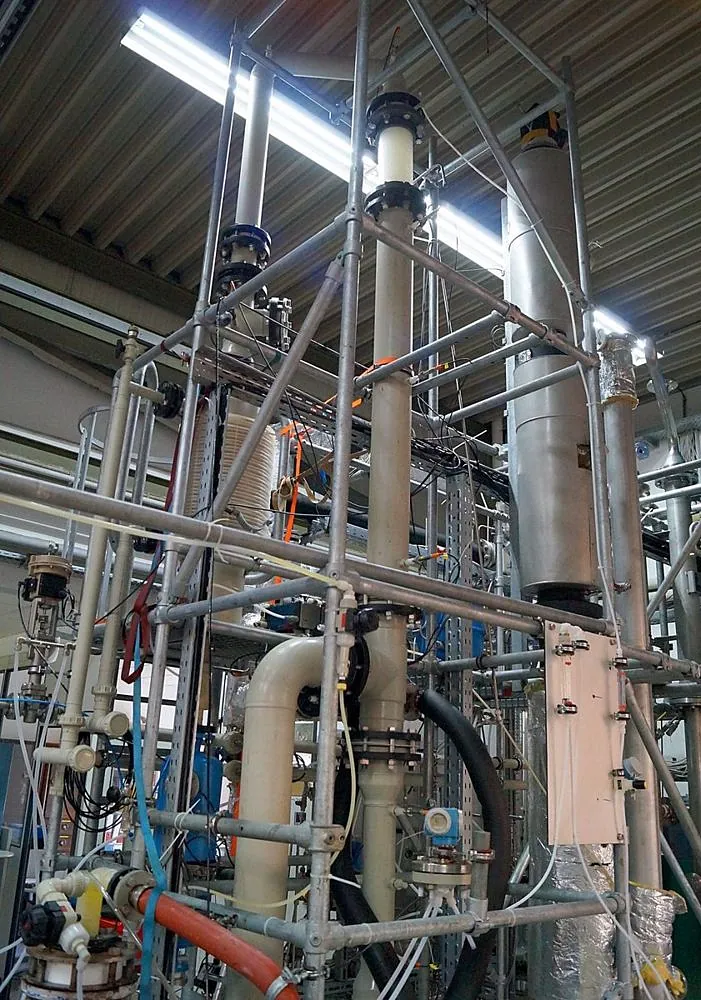
Utilities in the pilot plant
| Utility | Range |
|---|---|
| Hot water (electrically heated) | up to 90 °C |
| Thermal oil | up to 300 °C |
| Cooling water | cooling tower |
| Chilled water | from 2 °C |
Steam is not available in the pilot plant; higher temperatures are run with thermal oil.
How a test works
- Enquiry and questionnaire – you describe product, target and quantities; we propose the test scope.
- Laboratory test – feasibility with a small sample: boiling behaviour, boiling point elevation, concentration, crystal formation.
- Pilot plant test – near production, continuous, in the materials of the future plant.
- Report – measured values, balances, observations and a recommendation for the process.
- Design – based on the test data, up to the guarantee.

What we have already tested
Since 2008 every test series has its own number – by now more than 120. Examples, without customers and products:
- recovery of mineral and pickling acids
- rectification of hydrochloric acid above 20 % in a plastic column
- concentration of organic acids and phenolic solutions
- crystallisation of metal salts, amino acids and process solutions
- concentration of fermentation solutions
- recovery of solvents from cleaning processes
- extraction of metals and valuable substances from aqueous solutions
- treatment of oils and distillation of raw materials from biodiesel production
Tests at your site
If your product cannot be shipped or a long-term test is needed, talk to us – together we clarify how the test can be carried out.

Frequently asked questions
How much sample do you need?
That depends on the task and the scale – much less in the laboratory than in the pilot plant. As a rule we need no more than 3 to 4 m³ of sample material; for special engineering and feasibility studies the quantity varies.
How long does a test take?
That depends on the task and the scale. You receive the schedule with our quotation.
What does a test cost?
It depends on the scope; you receive a quotation beforehand. Laboratory tests cost considerably less than pilot plant tests.
Is our data kept confidential?
Yes – on request with a non-disclosure agreement before the test.
Do you also test corrosive media?
Yes – in plastic, glass and special-material equipment.
Further reading: Rectification · Evaporation technology · Crystallisation · Liquid-liquid extraction · Heat pump evaporator · Zero liquid discharge · Special materials