Zero liquid discharge – processes without waste water
Zero liquid discharge (ZLD) means that no waste water leaves the site. The water is recovered as distillate and reused; the dissolved substances leave the plant as a solid. Reasons are discharge limits, disposal costs, water scarcity or the value of the recovered substances.
How ZLD works
- Pre-concentration – evaporation in a falling film, forced circulation or heat pump evaporator; most of the water is removed here with little energy.
- Crystallisation – evaporative or cooling crystallisation when a usable salt is to be recovered.
- Drying – the thin film dryer (TFD) evaporates the remaining solution down to a free-flowing solid.
- Distillate return – as process or rinse water.
Which steps are needed depends on composition, quantity and target. ZLD can be achieved in many ways – we frequently use the thin film dryer for it.
Thin film dryers for ZLD
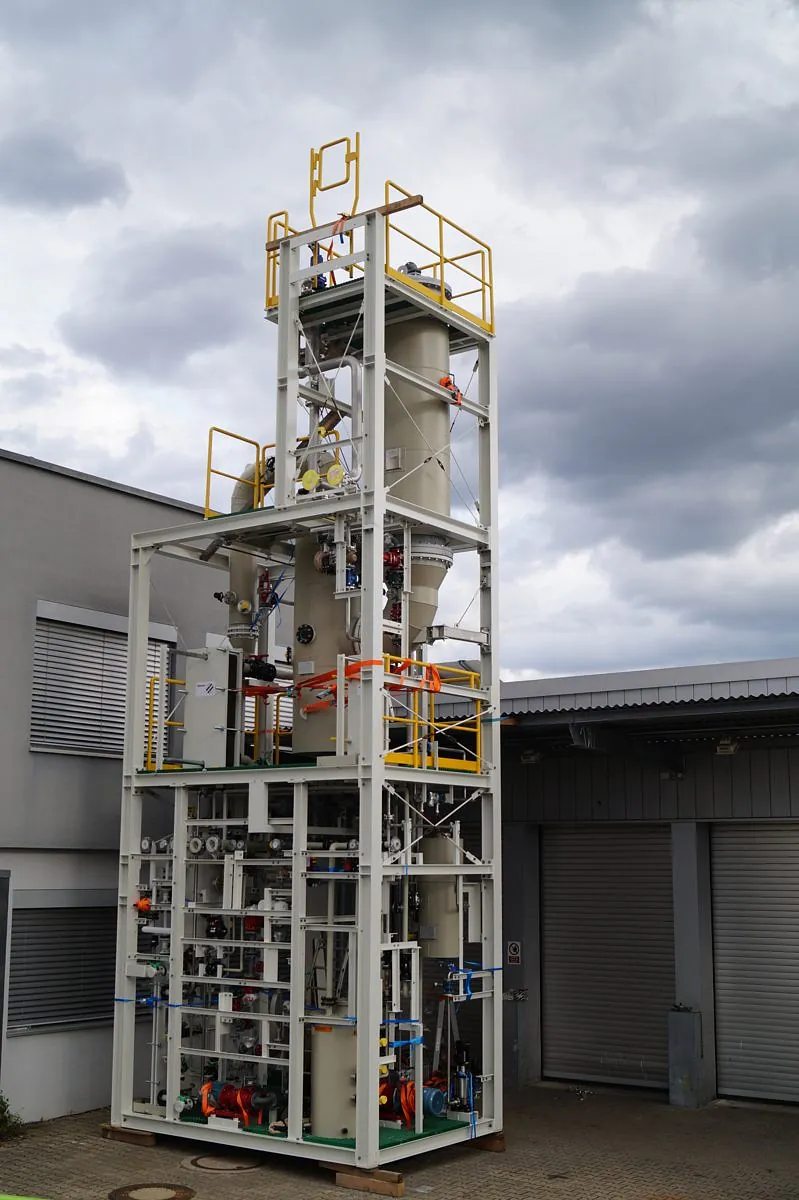
In the thin film dryer a rotor spreads the solution as a thin film on the heated wall. The water evaporates and the solid is discharged – continuously, even with fouling and highly concentrated solutions.
We have delivered thin film dryers from 1 to 16 m² heating surface, among others for salts such as sodium sulphate and sodium chloride, in materials such as 1.4529, 1.4539, Alloy 904L and AISI 316. Larger sizes on request. More on the design: drying technology.

Where ZLD is used
- Surface treatment and electroplating: rinse water and spent baths
- Waste water treatment: concentrates, e.g. from membrane processes
- Chemicals: saline process waste water
Energy
Energy demand decides on economic efficiency. Heat pump evaporators such as CONfix and vapour recompression reduce it considerably in pre-concentration – see heat pump evaporator.
Test first
Salts behave differently: boiling point elevation, fouling, moisture of the end product. We check this beforehand with your sample in our testing laboratory and pilot plant – from evaporation through crystallisation to drying.

Frequently asked questions
What is zero liquid discharge?
A process without any waste water: the water is recovered as distillate, the dissolved substances leave the plant as a solid.
Does every ZLD plant need a dryer?
No. If a concentrated sludge or a salt with residual moisture is acceptable, evaporation and crystallisation are sufficient.
Which materials are used?
Depending on chloride and acid content: high-alloy steels, nickel-based alloys, titanium or plastics – see special materials.
What happens to the distillate?
It is returned as process or rinse water; if volatile components are present, with after-treatment where required.
Further reading: Evaporation technology · Drying technology · Crystallisation · Heat pump evaporator · Acid and pickling bath regeneration · Special materials